Your home's energy rating, bared
Your house has 65 other things to check
Get the full Eavesdrop read — £9.99, up to 66 sources, PDF in 30 seconds.
Get your Eavesdrop reportGet 6 home-buying tips by email — free
Common questions
- What does an EPC rating actually mean?
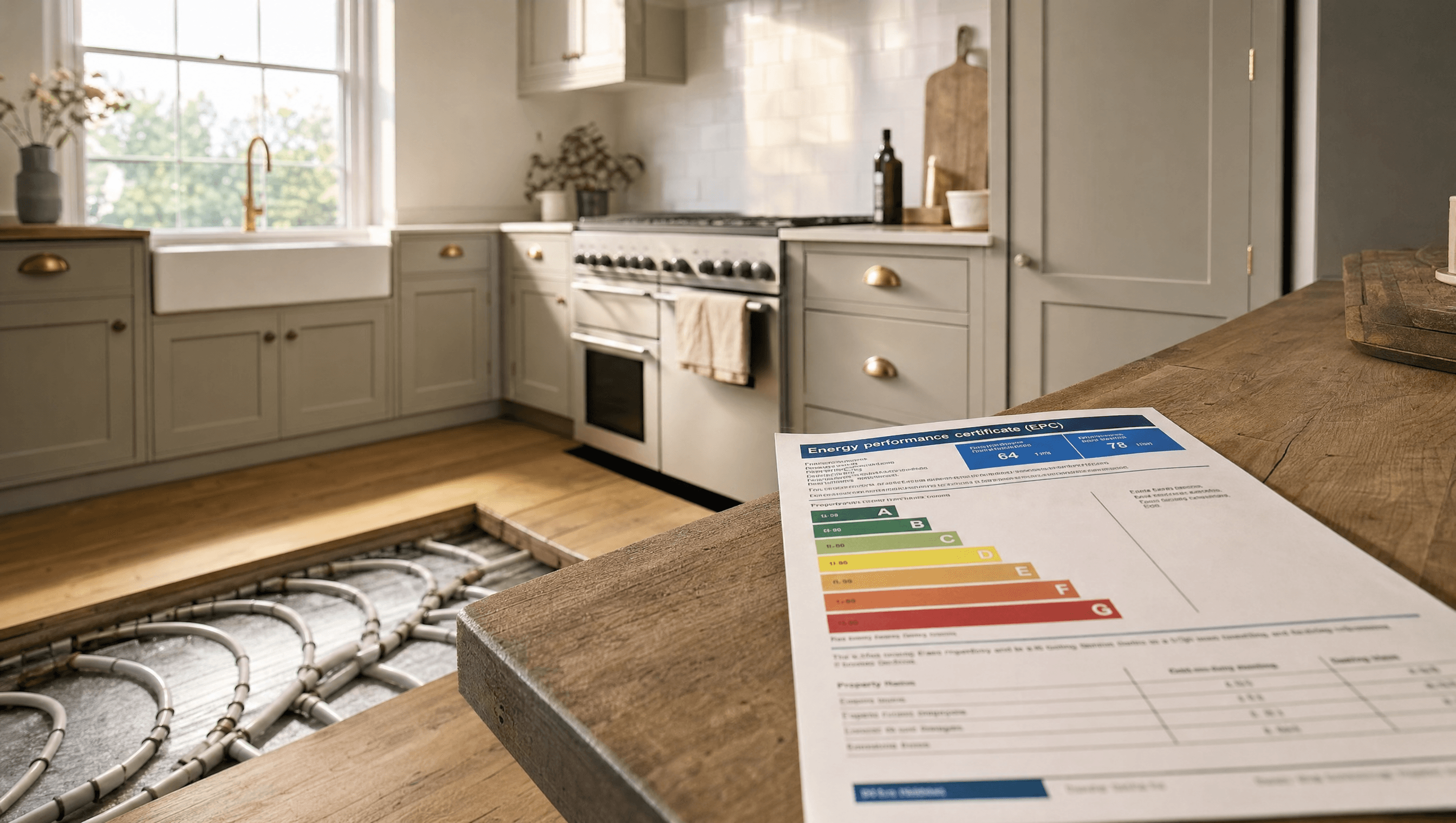
- An EPC (Energy Performance Certificate) rates a home's energy efficiency on a scale from A (most efficient) to G (least efficient). It considers insulation, heating systems, windows and other factors. The certificate also includes a recommended rating — what the home could achieve with cost-effective improvements.
- Is an EPC rating a legal requirement?
- Yes. In England, Wales and Northern Ireland, an EPC must be obtained before a property is marketed for sale or rent. The certificate is valid for 10 years and must be made available to prospective buyers or tenants free of charge. Failing to provide one can result in a fixed penalty.
- What's a 'good' EPC rating in the UK?
- Bands A and B are excellent — fewer than 4% of UK homes currently achieve them. Band C is widely considered the minimum acceptable standard; the government's previous target required most rented homes to reach C by 2025 (now under review). Bands F and G indicate a property may be costly to heat and hard to mortgage.
- How accurate is an EPC?
- EPCs are produced by accredited domestic energy assessors (DEAs) using standard software. They model energy use rather than measuring it, so actual bills can differ — especially for older homes with unusual construction. The certificate reflects the property, not occupant behaviour. Data shown here comes directly from the MHCLG open data register.
- Will my mortgage be affected by an EPC band?
- Increasingly, yes. Several major lenders offer preferential rates for Band A or B homes (green mortgages). Some lenders are also tightening criteria for F and G properties. From 2025, new-build lending requirements are stricter on energy standards. Check your lender's terms if the EPC band is borderline.