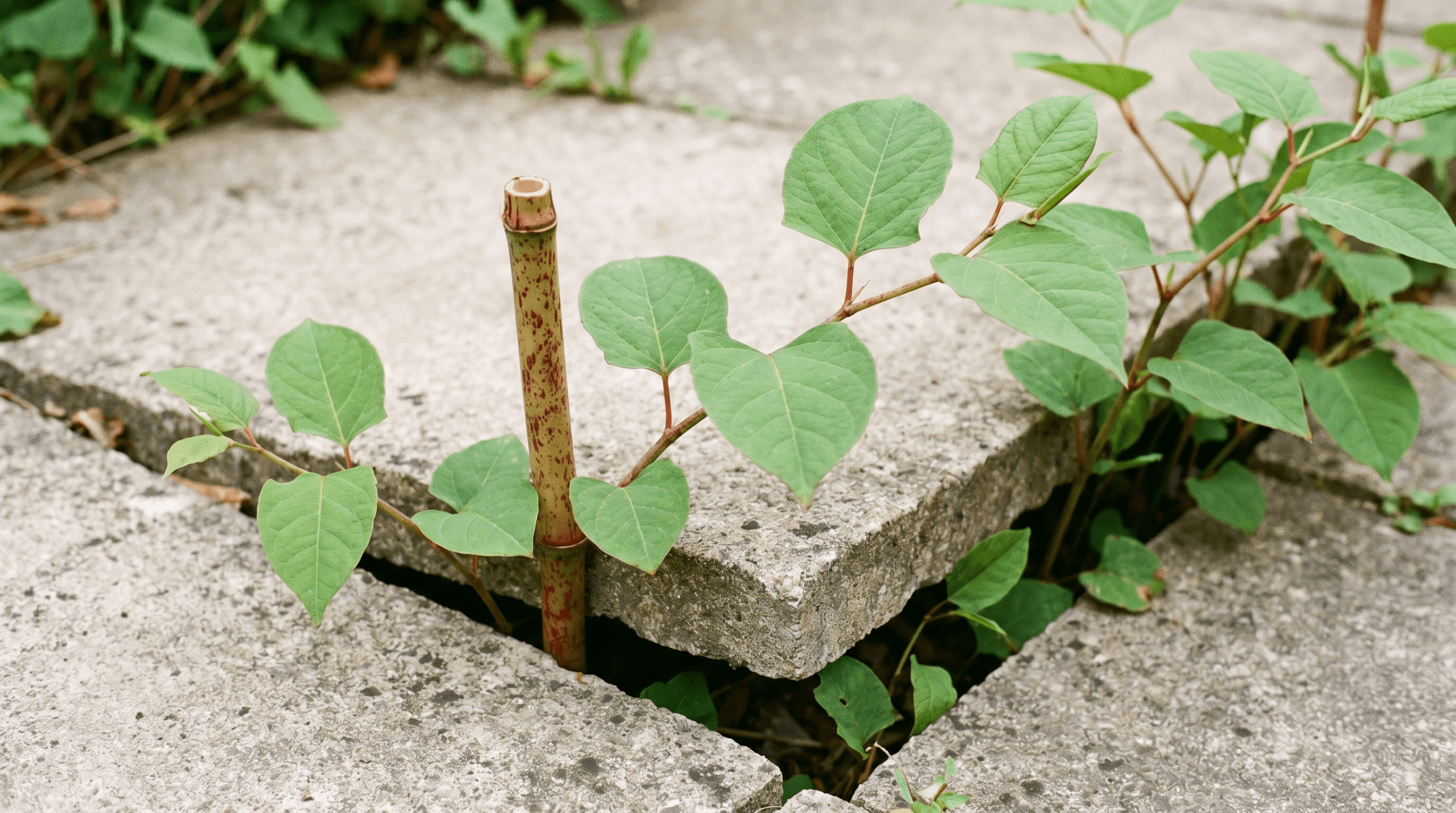
Japanese knotweed and liability.
Eavesdrop cross-references 66 sources public registers before you offer. For properties where Japanese knotweed is detected, the report tells you the RICS category, the seller's disclosure status, and whether a management plan is in place — before you instruct a solicitor.
What Japanese knotweed actually is
Fallopia japonica was introduced to Britain as an ornamental plant in the 1850s. It grows up to 10 cm per day during the summer season and can push through concrete foundations, drainage systems, and cavity walls. It produces underground rhizomes that extend up to 7 metres horizontally and 3 metres deep — fragments as small as 1 cm can regenerate a new plant (citing RICS Information Paper: Japanese Knotweed and Residential Property, 2022 edition).
Its presence at or near a property is not merely cosmetic. Mortgage lenders and surveyors treat it as a material factor in property valuation because remediation costs are significant, treatment timescales span multiple growing seasons, and undisclosed knotweed historically resulted in litigation between buyers and sellers.
The seller's disclosure obligation: TA6 Q7.8
The Law Society TA6 Property Information Form (Edition 4, 2021) requires sellers to answer question 7.8: "Is the property affected by Japanese knotweed?" The seller must declare whether knotweed is present on the property, has been treated, or is the subject of a professional management plan (citing Law Society TA6 Form, Edition 4, 2021).
A false answer or deliberate omission can constitute misrepresentation under the Misrepresentation Act 1967. Several buyers have recovered damages from sellers who denied knotweed presence subsequently confirmed by survey. The Law Society updated the TA6 form specifically because knotweed disclosure was inconsistently handled under the previous edition.
The legal precedent: Network Rail v Williams
In Network Rail Infrastructure Ltd v Williams [2018] EWCA Civ 1514, the Court of Appeal held that allowing Japanese knotweed rhizomes to encroach onto neighbouring land constitutes an actionable private nuisance. The case arose because knotweed from Network Rail's embankments had spread into adjacent residential gardens, reducing property values and preventing owners from selling.
The significance for buyers: a neighbour's knotweed can generate your liability even if your land is currently unaffected. Once you are aware of encroachment and take no action, you may inherit the nuisance. Eavesdrop checks neighbouring planning applications that reference knotweed remediation as a proxy for adjacent risk.
RICS risk categories and mortgage decisions
The RICS Information Paper (2022) defines four risk categories for Japanese knotweed. These categories are adopted by most UK mortgage lenders when deciding whether to lend (citing RICS Information Paper: Japanese Knotweed and Residential Property, 2022, Table 2):
Treatment options and realistic costs
Herbicide treatment (typically glyphosate-based) requires a minimum of three applications across two growing seasons. For a standard residential plot, expect costs of £1,000–£3,000 for the treatment programme plus an insurance-backed guarantee. Treatments must be carried out by a contractor accredited under the Property Care Association invasive weed control standard (citing Property Care Association Invasive Weed Control Contractor Registration Scheme).
Where development is planned or timescales are short, excavation and removal is sometimes specified. Costs vary by volume: a small garden infestation may cost £5,000–£8,000 to excavate; larger infestations or those affecting foundations can exceed £20,000. Excavated material is classified as controlled waste and must be disposed of at a licensed facility (citing Environment Agency knotweed guidance, Environmental Protection Act 1990 §34).
What the "7-metre rule" actually means now
Earlier RICS guidance (pre-2022) treated 7 metres from the property boundary as a bright-line threshold. The 2022 RICS Information Paper updated this approach: the 7-metre distance is now one factor in a broader risk assessment rather than a pass/fail trigger. An infestation 8 metres away may still be Category 2 if rhizomes are actively extending toward the habitable structure (citing RICS Information Paper: Japanese Knotweed and Residential Property, 2022 — abolition of strict 7-metre rule).
For buyers, this means a Category 1 classification requires a current inspection report from a qualified surveyor — not just a distance estimate from aerial imagery. Eavesdrop surfaces available satellite data and neighbouring planning application references, but a specialist survey remains necessary for a definitive category determination.
What Eavesdrop checks
For every property report, Eavesdrop checks: environmental baseline data from specialist remediation registers, satellite imagery to identify dense vegetation patterns consistent with knotweed during growing season, and neighbouring planning applications submitted to the local planning authority register that reference knotweed remediation or Japanese knotweed management plans. Where knotweed indicators are detected, the report surfaces the data with source citations so you can commission a specialist survey before exchange.
Check japanese knotweed for your property
£9.99 · up to 66 sources · 30 seconds
Get your Eavesdrop report