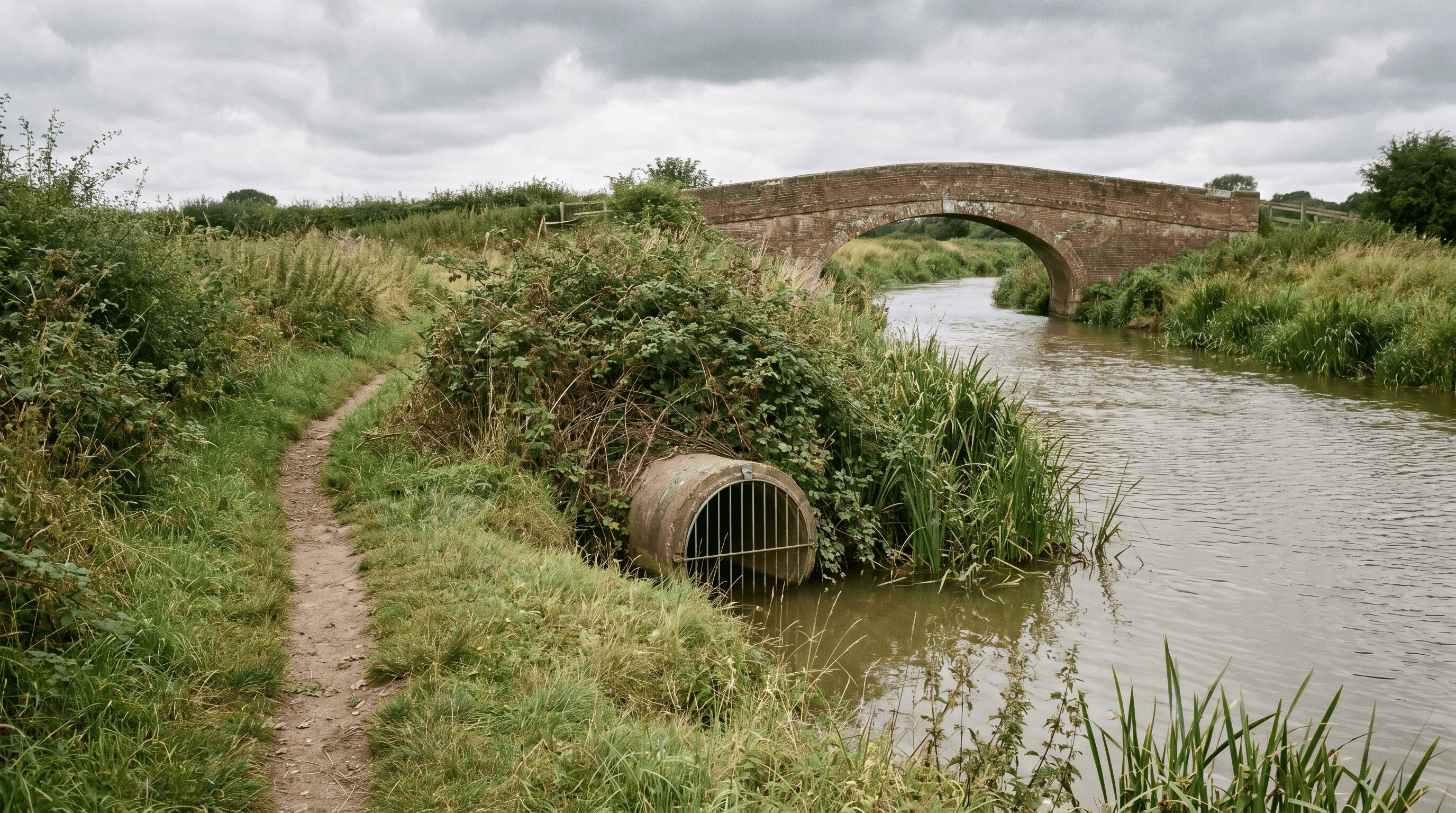
Sewage proximity, named.
Eavesdrop checks 66 sources public registers before you offer. For sewage proximity, the report names every Environment Agency consented discharge within 500 metres of the property, the nearest storm overflow and its annual duration data, and the bathing water classification for the nearest designated water — all sourced from publicly available Environment Agency data.
The 2024 storm overflow data — what it shows
The Environment Agency publishes Event Duration Monitoring (EDM) data for every storm overflow in England. EDM records how many hours each overflow actually discharged in a given year, and how many discharge events occurred. The 2024 EDM data, published in 2025, showed that storm overflows in England discharged for approximately 3.6 million hours across around 15,000 discharge points — a reduction from the 2023 figure of 3.6 million hours but still equivalent to an average of over 240 hours of discharge per overflow per year (citing Environment Agency Event Duration Monitoring 2024 Annual Report).
Individual overflow performance varies dramatically. Some overflows recorded zero discharge hours in 2024; others discharged for several thousand hours. The EDM data is published by discharge point reference number and geographic coordinates, allowing analysis by postcode or river catchment. Eavesdrop identifies the nearest EDM point to every property and reports its 2024 discharge duration.
The EA Consented Discharges register
The Environment Agency maintains the Consented Discharges register via its open data service. The register records every legal discharge consent in England — points where a water company, industrial operator, or other entity is permitted to discharge treated or semi-treated effluent to a watercourse or groundwater (citing Environment Agency Consented Discharges FeatureServer, publicly accessible via the EA open data API).
Each consent record includes: the discharge point location (easting and northing), the consent holder (typically a water company or industrial operator), the receiving water body, the permitted conditions (flow rate, effluent standard, monitoring requirements), and the consent status (active, revoked, or expired). A consent does not mean continuous discharge — it means discharge is permitted when the operator meets the consent conditions. A revoked consent indicates a prior discharge point that is no longer active.
Combined Sewer Overflows vs Storm Overflows
Two related but distinct discharge types matter for property buyers (citing EA storm overflow definition, published by the Environment Agency in guidance supporting the Water (Special Measures) Act 2025):
Bathing water classifications
The Environment Agency tests water quality at designated bathing waters — over 400 coastal and inland sites in England — and classifies each as Excellent, Good, Sufficient, or Poor based on the concentration of intestinal enterococci and E. coli in water samples taken across the bathing season (citing Environment Agency Bathing Water Quality classifications, published under the Bathing Water Regulations 2013).
A "Poor" classification means the site regularly exceeds microbiological limits. Bathing at a "Poor" site is not recommended by the EA during the bathing season. For properties near a river, lake, or coastal bathing site, the classification is a proxy for the overall water quality in that stretch — relevant to amenity, outdoor recreation, and in the case of coastal properties, property values. Eavesdrop reports the bathing water classification for the nearest designated water to every coastal or riverside property.
The Water (Special Measures) Act 2025
The Water (Special Measures) Act 2025 received Royal Assent in February 2025. It significantly strengthens the regulatory regime for water company discharges, including mandatory real-time monitoring of all storm overflows by 2030, new criminal liability provisions for water company executives where discharges are illegal, automatic and significant penalties for illegal discharges, and mandatory reduction targets for overflow frequency (citing Water (Special Measures) Act 2025).
For buyers, the Act's most immediately useful effect is enhanced data availability: water companies are required to publish near-real-time data on storm overflow activity, which Ofwat monitors for compliance. This data, combined with the pre-existing EDM annual reporting, makes it possible to assess the discharge history of overflows near any property with greater precision than was previously possible.
Buyer implications — odour, flooding, and amenity
Three material factors matter for property buyers near sewage infrastructure. First, odour: properties within 100–200 metres of a sewage treatment works or high-frequency CSO can experience seasonal odour during warm weather. Second, CSO failure risk: in extreme rainfall events, CSO infrastructure can back up and cause sewer flooding within properties if the sewer system is overloaded upstream. Third, amenity impact: degraded water quality in a nearby river or coastal stretch reduces recreational value, which is measurable in property premiums for riverside or seafront locations.
The ONS House Price Index coastal premium analysis shows that properties near beaches with "Excellent" bathing water classification command a premium over those near beaches rated "Sufficient" or "Poor" (citing ONS House Price Index geographic analysis). Where a bathing water has declined from Excellent to Good or Sufficient in recent years, the direction of travel is relevant to long-term value.
What Eavesdrop checks
For every property report, Eavesdrop checks: EA Consented Discharges within 500 metres (by UPRN coordinates), including consent holder, receiving water body, and consent status; nearest storm overflow and its 2024 EDM discharge duration and event count; bathing water classification for the nearest designated bathing water; and the water company responsible for the catchment. Where discharges are detected within proximity thresholds, the report identifies each by reference number and describes the consent conditions in plain language.
Check sewage proximity for your property
£9.99 · up to 66 sources · 30 seconds
Get your Eavesdrop report