Japanese knotweed, identified
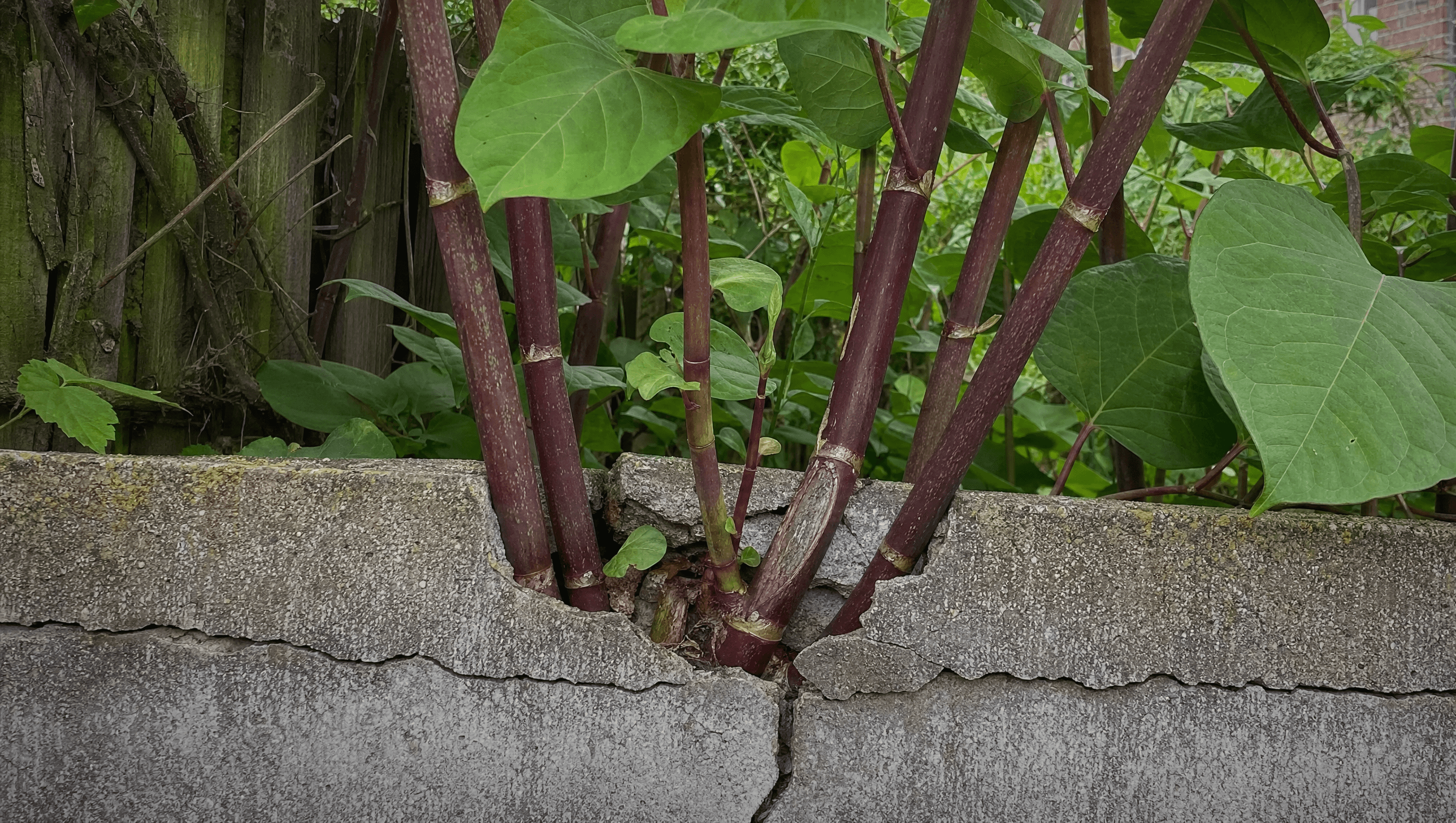
1.Are the stems hollow and bamboo-like, with distinct nodes (joints)?
Mature knotweed stems are hollow like bamboo, green with purple speckling, and have clearly raised nodes at intervals of 2–4 cm.
2.Are the leaves broad and shovel-shaped, roughly 10–15 cm long?
Knotweed leaves are heart-shaped at the base, tapering to a point. They grow in a distinctive zigzag alternating pattern along the stem.
3.Do the stems grow in a zigzag pattern from node to node?
Each leaf grows at an angle from the stem at the node, causing a characteristic zigzag silhouette — a key visual identifier from a distance.
4.Do young stems or leaf nodes show reddish-purple speckles or a reddish tinge?
Young knotweed shoots emerge red-purple in spring, resembling asparagus spears. Mature stems retain reddish-purple flecks.
5.In late summer (August–September), are there small cream-white flower clusters along the stems?
Knotweed flowers in late summer with dense sprays of tiny cream-white blossoms. The plant dies back completely in winter.
Answer all 5 questions to see your result.
Or upload a photo
in-memory only — never storedImage is processed in-memory only — we never store it. JPEG, PNG, or WebP up to 5 MB.
Drop a photo here, or click to browse
JPEG, PNG, WebP · max 5 MB · max 4096×4096 px
See our guide: Japanese knotweed and your mortgage. Coming soon: UK knotweed heatmap by postcode.
Your house has 65 other things to check
Get the full Eavesdrop read — £9.99, up to 66 sources, PDF in 30 seconds.
Get your Eavesdrop reportGet 6 home-buying tips by email — free
Common questions
- What does Japanese knotweed look like?
- Japanese knotweed (Fallopia japonica) has several distinctive features: hollow bamboo-like stems with raised nodes, broad shovel-shaped leaves (10–15 cm) that grow in an alternating zigzag pattern, reddish-purple speckled young shoots in spring, and dense sprays of tiny cream-white flowers in late summer (August–September). In winter the plant dies back completely, leaving brown hollow canes. The combination of hollow stems, the zigzag pattern, and the shovel-shaped leaves is usually decisive. When in doubt, consult a Property Care Association (PCA) qualified surveyor — the five-question checklist above is a starting guide, not a definitive identification.
- Why does Japanese knotweed matter for mortgages?
- Most major mortgage lenders follow RICS guidance note on Japanese knotweed (2022 update), which categorises knotweed risk into four categories based on distance from the property and any active management plan. Knotweed within 7 metres of a habitable space without a professional management plan is classed as Category 3 or 4 — lenders including Halifax, NatWest, and Nationwide may decline to lend or require a PCA-approved treatment plan as a condition of offer. An approved professional management plan (typically 5–10 years, costing £2,000–£15,000) with an insurance-backed guarantee reassures most lenders. Sellers must disclose knotweed on the TA6 Property Information Form under TA6 Q7.4 (since April 2020).
- What is the legal liability for Japanese knotweed?
- A landowner can be liable in private nuisance if knotweed encroaches onto a neighbour's land. In Williams v Network Rail Infrastructure Ltd [2018] EWCA Civ 1514, the Court of Appeal confirmed that allowing knotweed to spread from your land constitutes a nuisance even before it causes physical damage — the mere presence near the boundary and potential for spread is sufficient. Damages in that case were awarded to compensate for diminution in property value. Under the Infrastructure Act 2015 Schedule 9, causing or permitting Japanese knotweed to spread is also an environmental offence carrying a fine of up to £2,500. Sellers must disclose it; failure to do so may give buyers a misrepresentation claim.
- What does knotweed look like in spring, summer, and winter?
- Spring (March–May): Knotweed emerges as distinctive red-purple asparagus-like spears, unfurling into heart-shaped leaves. Growth is extremely rapid — up to 10 cm per day in ideal conditions. Early identification is critical because the shoots are softer and treatment is more effective. Summer (June–September): The plant reaches full height (1–3 metres) with bamboo-like stems and dense green foliage. Cream-white flower clusters appear August–September. Autumn (October–November): Leaves turn yellow and die back; flowers produce winged seeds. Winter (December–February): All visible growth dies back to brown hollow canes. The rhizome (root system) remains alive underground, often extending 3 metres deep and 7 metres laterally — treatment is required year-round.
- What should I do if I find Japanese knotweed?
- Step 1: Do not disturb — cutting or strimming can spread knotweed via fragments, making it a controlled waste under the Environmental Protection Act 1990. Step 2: Instruct a Property Care Association (PCA) affiliated specialist to confirm identification and prepare a professional management plan. Step 3: If buying a property: commission a specialist knotweed survey and factor the management cost (typically £2,000–£15,000 over 5–10 years) into your offer. Step 4: If selling: disclose on the TA6 form and provide evidence of any active management plan with an insurance-backed guarantee. Step 5: Never dispose of knotweed in domestic waste — it must be transported by a licensed waste carrier to a licensed landfill site as Schedule 22 controlled waste.